Semen Biochemistry
The semen sample consists of the spermatozoa and the seminal plasma, the sum of secretions that originate mainly from the seminal vesicles, the prostate and the epididymis. These secretions come together at ejaculation.
If an obstruction exists in the male reproductive system the spermatozoa are not found in the ejaculate and the sample is azoospermic. An obstruction also blocks the flow of the secretions from the glands. An obstruction at the ejaculatory ducts will prevent the secretions from all the glands to go through whereas if the obstruction is at the level of the epididymis only the secretion of the epididymis will be blocked.
Semen biochemistry is needed when obstruction in the male reproductive system is suspected and can also determine the site of the obstruction based on the presence or absence of certain molecules.
General Information
A semen sample consists of spermatozoa and seminal plasma, which is a mix of a number of secretions. These secretions come mainly from parts of the male reproductive system such as the epididymis, the prostate and the seminal vesicles.
If there is an obstruction at any point in the male reproductive system then the spermatozoa are not found in the ejaculate. Depending on the site of the blockage, the fluids secreted by the epididymis, the prostate and the seminal vesicles are also not found in the ejaculate. In order to detect the point of occlusion a number of marker molecules are used.
In particular, the presence of fructose, which originates from the seminal vesicles, α-glucosidase, which is secreted by the epididymis, and acid phosphatase, which originates from the prostate, are measured. For the prostate there are other marker molecules that give information about its functionality such as zinc, citric acid and magnesium. So the determination of these molecules is very useful in cases of obstruction.
The secretory activity of the accessory glands can also be affected by the presence of microorganisms. Infection can cause a temporary decrease in the secretory activity but sometimes the decrease at the secretory epithelium can be irreversible and result at low quality semen sample. The measurement of the marker molecules such as fructose and acid phosphatase can access the function of the glands.
Fructose
Usually, a semen sample is considered normal, when its volume is more than 1.5 ml. However, there are samples with a very small volume – 0.3 or 0.5 ml. These samples do not contain any spermatozoa, that is, they are azoospermic samples. An obstruction in the male reproductive system can be the cause of azoospermia. The measurement of fructose, is a routine way to detect an obstruction in the male reproductive system.
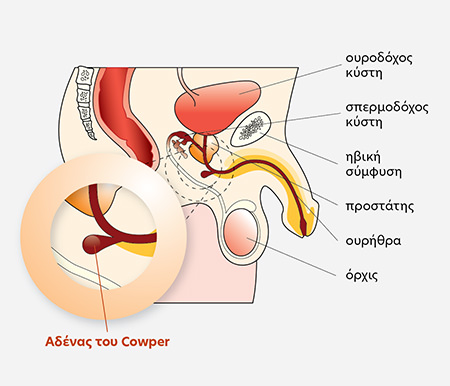
Fructose comes from the seminal vesicles, which are small sacs that produce the fluid that makes up 60-70% of the ejaculate volume. In cases where the obstruction is in the ejaculatory ducts the fluid produced by the seminal vesicles cannot go through. Then the amount of fructose in the semen sample will be zero and this is indicative of obstruction.
Acid Phosphatase
Usually, a semen sample is considered normal, when its volume is more than 1.5 ml. However, there are samples with a very small volume – 0.3 or 0.5 ml. These samples do not contain any spermatozoa, that is, they are azoospermic samples. An obstruction in the male reproductive system can be the cause of azoospermia. The measurement of acid phosphatase, is a routine way to detect an obstruction in the male reproductive system.
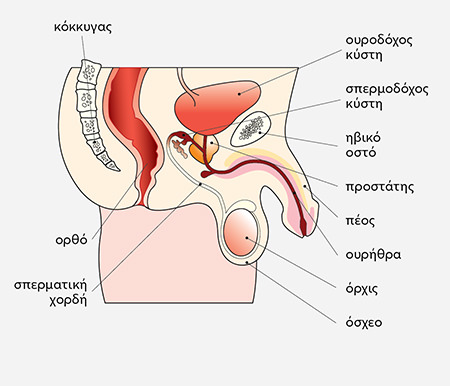
Acid phosphatase is derived from the prostate, a small chestnut-shaped gland. The prostate produces a fluid that makes up 30-40% of the volume of ejaculation. Prostate secretions contain acid phosphatase, zinc, citric acid and other substances, all of which have the same diagnostic capacity.
In cases where the obstruction is near the prostatic urethra , the fluid produced by the prostate cannot go through. As a result, the amount of acid phosphatase in the sperm plasma will be zero and the measurement of acid phosphatase, as well as the measurement of fructose, indicates that an obstruction exists in the male reproductive system.
A-glucosidase
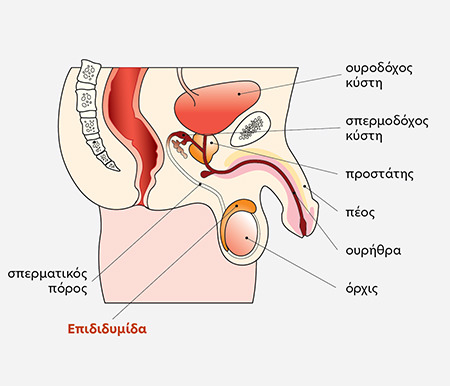
Azoospermia is the condition in which there are no spermatozoa in the ejaculate. There are many causes for azoospermia, one of which is the obstruction of the vas deferens, ie the “cord” that carries the spermatozoa to the urethra. In cases where an obstruction exists near the epididymis, the spermatozoa, which are normally produced in the testes, cannot reach the ejaculate. The same is true for α-glucosidase, an enzyme which is secreted by the epididymis.
In cases of azoospermia, where the semen sample has a normal volume and a normal pH, α-glucosidase should be measured. If α-glucosidase is not present in the ejaculate an obstruction of the vas deferens near the epididymis exists. (Α-glucosidase, Mahmoud-et-al, 1998).
FAQs
When do we need semen biochemistry ?
Semen biochemistry is necessary when there are no spermatozoa in a semen sample, ie in cases of azoospermia.
One of the causes of azoospermia is obstruction that occurs in the male reproductive system. The obstruction can be confirmed by the use of marker molecules. Fructose, acid phosphatase and a-glucosidase are routinely used when obstruction is suspected and, depending on the marker molecule, the location of the obstruction can also be determined.


When is only the measurement of a-glucosidase needed ?
Usually, when an obstruction occurs, the semen sample has a very low volume and a low pH. There are samples however, that are azoospermic due to obstruction but the volume of the semen sample is normal. In these cases the obstruction is near the epididymis and does not obstruct the passage of the liquids produced by the prostate and the seminal vesicles. Since neutral a-glucosidase is exclusively produced by the epididymis, a-glucosidase is the marker that can detect the obstruction near the epididymis.
How are the measurements of semen biochemistry done ?
The secretions of the accessory glands are detected in the seminal plasma by the methods proposed by the WHO Laboratory Manual for the Examination and Processing of Human Semen. The methods of detection are based on the spectrophotometric detection of the compound of interest, after biochemical reactions. The absorption read by the photometer is converted to the amount of the substance with the use of a standard curve.

Semen analysis
The first step in the investigation of male fertility is the semen analysis. The semen analysis provides useful information, such…
more
Intrauterine Insemination
Studies wordwide have shown that 15-20% of couples have difficulty having a child. The causes of infertility are many: in…
more
Antisperm Antibodies
What are the antibodies? Antibodies are protein molecules that are produced by our body’s immune system. Antibodies protect our body…
more