I need a donor sample
There are many reasons why a couple has difficulty in conceiving a child.
- Azoospermia, lack of spermatozoa from the semen sample, is the most common cause. In cases of non-obstructive azoospermia, the testes do not produce spermatozoa and the testicular biopsy cannot provide the couple with spermatozoa.
- In other cases, there are men with normal semen samples that should not have a child with their own sample. These men are carriers of inherited diseases and in case they conceive with their own biological material, they will pass on their disease to their descendants.
- Donor sperm is also necessary in cases of unmarried women who would like to have a child.
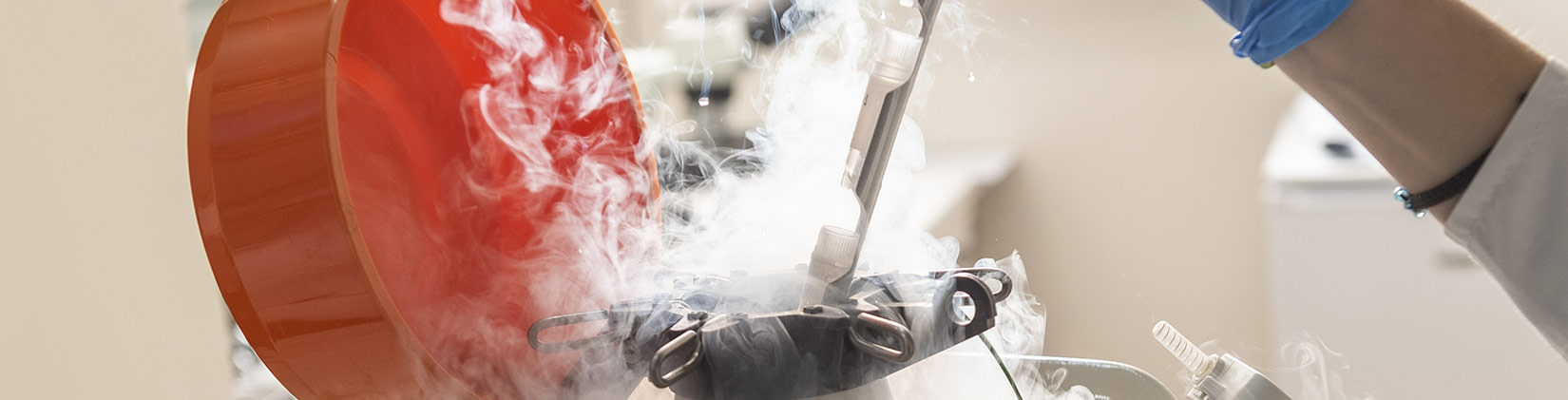
In all of these cases a sperm bank can help these people to make their dream of starting a family come true by using donor spermatozoa. Donor samples are cryopreserved and can be used in assisted reproduction, intrauterine insemination or in vitro fertilization and there is the option of a second or a third child with the sample from the same donor!
To ensure high quality services, sperm donation is governed by certain rules, namely:
- The use of fresh semen from a third donor is prohibited because some infectious diseases can develop. A semen sample is tested before cryopreservation and the test is repeated 6 months later. Only if the cryopreserved sample tests negative again after the 6-month period is released and can be used at assisted reproduction techniques.
- It is forbidden to use the sperm of more than one donor during a treatment cycle.
- Sperm donation in Greece is anonymous. Therefore, donor details are not disclosed to recipients. Accordingly, the details of the couple receiving the donor sample, as well as information about the child or children born through this procedure, are not disclosed.
- The maximum number of children from the same donor is ten (10).
- In case of pregnancy, the recipients are obliged to report to HSB the birth of the child (s).
Laboratory Tests Performed on Donor Samples
- Semen analysis (macroscopic and microscopic examination that includes measurement of sperm count, measurement and differentiation of round cells, assessment of motility, vitality and morphology of spermatozoa)
- Sperm vitality test after thawing
- Complete microbiological test including: aerobic and anaerobic culture for common pathogens, detection of Chlamydia trachomatis, Mycoplasma hominis, Mycoplasma genitalium, Ureaplasma urealyticum, Ureaplasma parvum, Neisseria gonorrhoxae, Haemophilus ducreyi, Treponema pallidum by PCR method and detection CMV by SPI method.
- Evaluation of sperm DNA fragmentation by flow cytometry
- Blood type / Rz
- Test for HIV (anti-HIV I / II), hepatitis B (HBsAg), hepatitis C (anti-HCV), serological detection of treponema (RPR / VDRL) and molecular test for HIV, HBV, HCV.
- Karyotype
- Test for Thalassemia, type a and b and type d, by molecular method.
- Test for sickle cell anemia
- Test for cystic fibrosis by full sequencing of the CFTR gene (NGS, >99% of known mutations), that have been detected in the Greek population.
- Test for spinal muscular atrophy (SMA) – the SMN1 / 2 gene
- Screening of antibodies against T-Lymphatic Viruses (HTLV-1 and 2)
Required Documents
Married Couple
- photocopy of IDs
- blood type tests by a microbiology lab
- marriage certificate
- recent marital status certificate / solemn declaration (in case a certificate of marital status is not issued in your country)
- document of permanent residence (applies to non-Greek residents)
Provided by SPERMIA
- signed consent in a special form
- solemn declaration for official information between your clinic and SPERMIA
- authorizations for the transfer of the sample
Couples in Civil Union
- photocopies of ID
- blood type tests by a microbiology lab
- deed of consent for couples in civil union
- recent certificates of marital status of the partners / solemn declaration (in case a certificate of marital status is not issued in your country)
- document of permanent residence (applies to non-Greek residents)
Provided by SPERMIA
- signed consent in a special form
- solemn declaration for official information between your clinic and SPERMIA
- authorizations for the transfer of the sample
Single-Parent Family
- photocopies of ID
- blood type tests by a microbiology lab
- deed of consent for couples in civil union
- recent certificates of marital status of the partners / solemn declaration (in case a certificate of marital status is not issued in your country)
- document of permanent residence (applies to non-Greek residents)
Provided by SPERMIA
- signed consent in a special form
- solemn declaration for official information between your clinic and SPERMIA
- authorizations for the transfer of the sample